
The Graduated Approach starts in the classroom. Teachers in school are continually assessing all learners, which informs their planning and implementation of their lessons. However, where a possible special educational need has been identified, this process will become more individualised and targeted at meeting the needs of the learner. The Code specifies that high quality teaching (known as Quality First Teaching QFT) with differentiated and personalised support should be the first reaction the SEN needs of a learner. Educators need to develop a clear understanding of the strengths, weaknesses, and challenges that the learner may have. This should include an understanding of any needs and challenges the caregivers may have as the family and home life will have a profound impact on the learner’s ability to manage the demands of any educational setting. The Code of Practice has an emphasis on setting aspirational targets to enable the learner to achieve good long-term outcomes to enable them to lead independent and successful lives. Early identification of SEN is key to supporting their needs. It is anticipated that assessment takes place in the learner’s early years, but this is not always the case and some learner’s needs go unidentified leading to challenges in later stages of their education.
The Code outlines the graduated approach through which earlier decisions and actions are revisited, refined, and revised, leading to a growing understanding of the child’s needs and what supports them in making progress and securing good outcomes.
There are four distinct stages to the graduated approach:
Assess, Plan, Do and Review
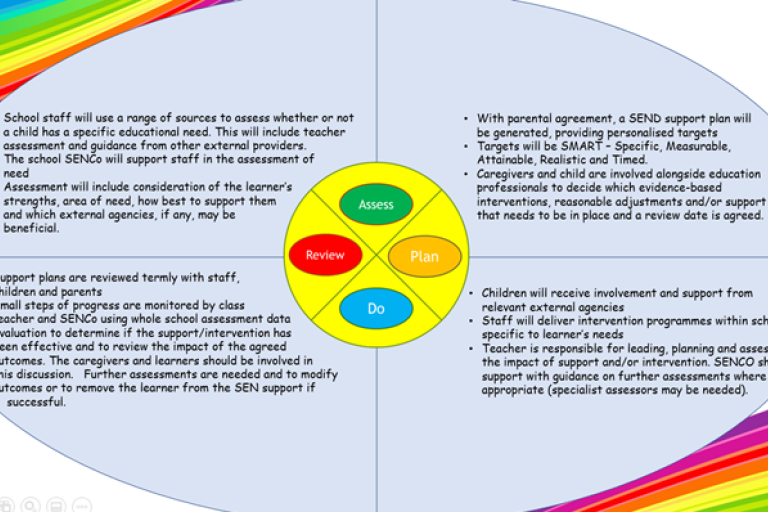
Within the educational setting there should be a structured process in school for teachers and support staff to share concerns when they identify that a learner is not making expected progress or where they are regressing, and it is felt that they may have a special educational need. High quality teaching must be targeted at the learner’s area of difficulty: observations, logging behaviour issues, individual assessments should be recorded to inform the graduated approach. This information is vital if referrals are to be made into the Resource and Support Panel or Multi-Agency Education Health and Care Plan Panel to seek more specialist support. Costed provision maps also give clear evidence of the interventions, support and/or resources that school are putting in to meet the learner’s needs and can be used as evidence if higher needs funding is required later.
At this stage, the learner may not be on the SEN Register but are being monitored – this would the Assessment stage. In most cases, an intervention may be all that is needed to overcome a learning difficulty or to catch up and close the gaps in their knowledge.
The Code states that when a child is identified as needing SEN support, the teacher working with the SENDCO should carry out a clear analysis of the child’s strengths and needs (DfE (Department for Education), 2015a). The purpose of this analysis is to gain an in-depth understanding of the learner’s needs to be able to effectively plan teaching approaches, to provide the most suitable provision/interventions and to inform of any adjustments that need to be made.
To identify the barriers to learning, SENDCo/Teacher may need to access individualised identification tools that should be available within school – assessment criteria and screening tools are widely available (if advice is needed, please contact the local authority SEN advisor or specialist teaching team). Hearing and sight checks should be requested through the GP or opticians and should be done as soon as there are concerns to eliminate any underlying physical needs before any SEN is explored. For example, research shows that learners who have suffered from glue ear in early life can have delays in the acquisition of early literacy skills. Information gathering should include an early discussion with the learner and their caregivers. These early discussions should be structured in such a way that they develop a good understanding of the pupil’s areas of strength and difficulty the caregiver's concerns, the agreed outcomes sought for the learner and next steps. This conversation will also create a partnership of support between school and home.
Initial and ongoing assessments should be reviewed regularly to ensure that support is bespoke to the learner’s needs. Where there is little or no improvement in progress, more specialist assessment may be required from specialist teachers or from health and/or social care. Learning assessments can be obtained through the Resource and Support Panel where access can be given to specialist teachers for learning or ASC or sought through private providers. When professionals such as CAMHS are not already working with the setting, the SENDCO should contact them, after gaining the caregiver’s agreement, for advice and guidance. Once information about the learner’s needs is gathered, there needs to be further discussion with the caregivers and the learner to develop a shared understanding of the child’s strengths and suggested outcomes to be achieved.
If after the first stage the Assess stage, a school decides that a SEN Support Plan is needed, this should be initiated by SENDCO/class teacher working in partnership with caregiver and learner. It must focus on the learner’s individual needs, not their SEN or disability label. The label itself will not be sufficient to explain any barriers to learning due to variance that a disability may have. The language used in the plan should be child-centred and the outcomes written in such a way that they can be easily understood by the learner and caregivers. Most plans will identify three to four outcomes, which focus on supporting their wellbeing, not just developing academic skills. They should be personalised and agreed by all parties.
The learner, teacher and caregiver need to agree:
- The outcomes to be achieved.
- The interventions, strategies, and support to be put in place.
- Identify a key person to deliver the support.
- When where and how often the support will be delivered.
- The expected impact on progress, development, or behaviour.
- A date/time for next review.
An outcome can be defined as ‘the benefit or difference made to an individual because of an intervention’ (DfE, 2015a: 163). An outcome is a change that you want to achieve, this can be relation to learning, behaviour, skills, or attitudes. There is not a dictated format for you to use for the ‘plan’ - schools use different methods such as Individual Education Plan, Pupil Passports, Personalised Learning Plan, or something else.